Robotics is not about the future, it’s already the present. We live in an age when even a schoolchild can build his own autonomous robot. In this project, we created a robot capable of detecting and avoiding obstacles using an HC-SR04 ultrasonic sensor and an Arduino Nano controller.
Project Objective
To create a simple but functional mobile robot that detects obstacles and independently chooses a route around them using basic principles of robotics and Arduino programming.
Objectives
- Design the structure and select materials;
- Select the necessary electronic components;
- Develop and implement the algorithm of obstacle avoidance;
- Debug and bring the robot to a working model.
Equipment and materials
Electronics:
- Controller: Arduino Nano (based on ATmega328);
- Distance sensor: HC-SR04;
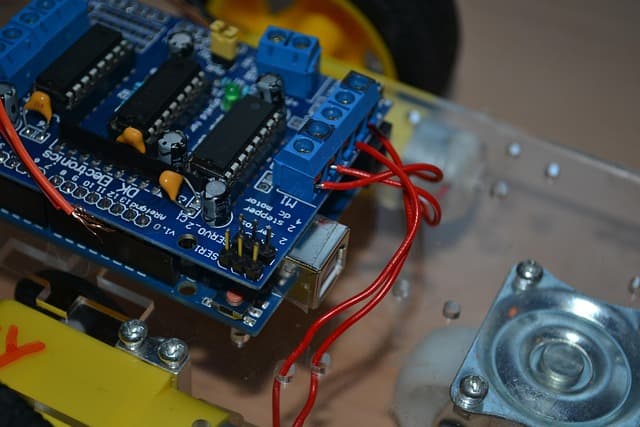
- Motor driver: L298N;
- 4 motors with gearboxes;
- Power supply: two Li-ion batteries (3.7V);
- Expansion board: Trema Nano Compact Shield.
Tools:
- Caliper, ruler;
- Soldering iron, multimeter;
- Torch, screwdrivers, pliers;
- Screwdriver, drills, vise grips;
- Laptop with Arduino IDE.
Design and assembly
The robot consists of a two-level platform cut out of sheet plastic:
- Lower level: placed batteries, motor driver, Arduino and motors.
- Upper level: a servo-motor with a rotary ultrasonic sensor is installed, which performs scanning of the surrounding space.
The HC-SR04 is attached to the rotation of the servo motor, which allows you to “look around” to the left and right, estimating the distance to the nearest objects.
Programming
The algorithm of the robot is realized in C++ language using Arduino IDE. The program works according to the following logic:
- The sensor turns left, straight and right scanning the distances.
- The robot analyzes the three directions.
- If there is an obstacle in front, it turns to the side where the distance is greater.
- If all directions are blocked, it turns 180°.
This approach allows the robot to make simple but meaningful decisions in a confined space.
Results
The robot successfully identifies and navigates around obstacles. In tests, it navigated confidently between boxes and walls, choosing a free path. A servo motor provides sensor rotation, and Arduino Nano provides control of all systems.
Development prospects
In the future, the design can be modernized:
- Installing infrared or ToF sensors (more accurately determine distance);
- Adding limit switches (contact detection of obstacles);
- Introduction of an electronic compass (directional orientation);
- Expanding the algorithm to autonomous route following mode.
You can also connect a Bluetooth module and control the robot from your smartphone.