Arduino and Raspberry Pi are popular single-board computers. Which one should you choose for your robot? What are the advantages of each board? Comparison in our article.
Probably everyone who is interested in robotics, DIY-electronics, has heard about Arduino and Raspberry Pi boards. Both are very popular boards (single board computers). Not surprisingly, they are often perceived as analogs and even competing hardware platforms designed to solve the same tasks. In fact, Arduino and Raspberry Pi have many differences.
The first thing you should pay attention to is that Raspberry Pi is a fully functional computer (more details in the article), while Arduino can hardly be called a computer.
Let’s take a closer look at the differences between Arduino and Raspberry Pi. This comparison will help you choose which of these two platforms best suits your needs and will be an effective base for your robot.
The Raspberry Pi hails from the United Kingdom. Inventor Eben Upton and his colleagues at Cambridge University Computer Laboratory created the Raspberry Pi as a cheap computer for educational purposes. Upton had been working on prototypes since 2006; the first batch of Raspberry Pi didn’t go on sale until April 2012.
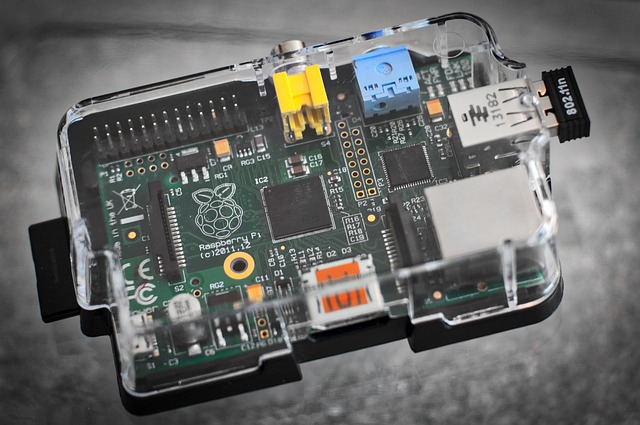
Raspberry Pi Model B
Arduino was born in Italy. Banzi, a teacher at the Ivrea Design Institute, wanted a simple and cheap hardware prototype for students. In March this year, the Arduino platform celebrated 10 years. There are several modifications of the board (Arduino Uno, Nano, Mega, etc.). In addition, due to the openness of the platform, many almost identical analogs of Arduino are produced (DCcduino, FreDuino, XDRuino, etc.).
Both Arduino and Raspberry Pi are suitable for beginners. But if you take a closer look at the hardware and software of these boards, it becomes obvious that they are designed for different types of projects.
Hardware and software of Raspberry Pi and Arduino
First, let’s take a look at some of the features from the board specifications that show the biggest differences between the Raspberry Pi and the Arduino.
The size of the two devices is comparable (if we take the most famous Arduino Uno). But that’s pretty much all that makes them similar to each other.
In terms of clock speed, the Raspberry Pi is 40 times faster than the Arduino. The difference is even greater in RAM: the Raspberry Pi has 128,000 times more RAM than the Arduino. Just don’t jump to conclusions based on these two vastly different specifications.
The Raspberry Pi is a computer that can run the Linux operating system, which supports multitasking. The USB ports can be used to connect various devices, for example for wireless Internet connection. In general, this tiny board is quite powerful and can function as a full-fledged computer (although, of course, Raspberry Pi cannot compete with modern personal computers and laptops in terms of power).
It may seem that Raspberry Pi is superior to Arduino. But this superiority is more in the software. For purely hardware projects Arduino is much better suited. Arduino has this advantage due to its simplicity.
Arduino is able to read analog signals better than Raspberry Pi and indeed in real time. This flexibility allows Arduino to work with almost any kind of sensor or chip. The Raspberry Pi is not as flexible, for example, it requires additional hardware to read analog sensors.
Arduino is less demanding on power supply. So, the recommended power supply for Arduino UNO is 7-12 volts, the voltage is stabilized to 5 volts. And the Raspberry Pi board requires strictly 5 Volts at the input, so to work with it you can’t do without a power filter with a current of 1A.
The Arduino IDE is much easier to use than Linux. For example, if you want to write a program to blink an LED from a Raspberry Pi, you have to install the operating system and some code libraries – and that’s just the beginning. On the Arduino, you can program a blinking LED using just eight lines of code. Since the Arduino isn’t designed to run an operating system or many applications, you can just plug in the board and get started.
The Raspberry Pi allows you to take advantage of multitasking; multiple programs in the background can run simultaneously. The Raspberry Pi, for example, can run both a print server and a VPN server at the same time.
On the other hand, you can leave an Arduino running some process connected for a long time, and simply disconnect the board later when you’ve decided to. The Arduino is simpler in this respect, it’s harder to damage.
The Arduino works with any computer and can run on battery power. The Arduino can be turned on and safely turned off at any time. The operating system on the Raspberry Pi can be damaged if you disconnect the board without properly shutting down.
With the Raspberry Pi, you should know something about Linux as well as a programming environment such as Python. On the other hand, the Raspberry Pi has the benefit of decades of Linux software.
Thus, while the Raspberry Pi has a tremendous advantage in software capabilities, the Arduino has an advantage in the ease of implementing hardware projects. The feasibility of using Raspberry Pi or Arduino depends on the project.
Raspberry Pi and Arduino work together
Raspberry Pi and Arduino complement each other. They work well together. Arduino is better for controlling motors, receiving signal from sensor, controlling LEDs etc. And an internet-connected Raspberry Pi is a mini computer that can not only play videos, music or send emails, but also run complex algorithms.
The easiest way to teach Raspberry Pi to communicate with Arduino is to use the Python PySerial library.
Using Arduino and Raspberry Pi together gives unlimited possibilities: Arduino can be used to control sensors and Raspberry Pi can be used to perform complex computational operations. Thus, it is possible to create robots more capable than robots built only on Arduino or Raspberry Pi.
Both Raspberry Pi and Arduino have fairly large and active communities. This, by the way, is one of the reasons for the popularity of these boards – you can always find an answer to almost any question you have when working with Arduino or Raspberry Pi. If we talk about the Russian-speaking segment, Arduino is still far ahead of Raspberry Pi in terms of the quantity and quality of available resources.
Also, Arduino nowadays has many more educational resources for beginners. Therefore, it is often advised to start learning with Arduino and then move on to learning Raspberry Pi.